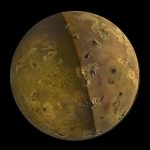
Alright, fellow planetary enthusiasts, prepare for a fiery journey to Jupiter’s Volcanic Moon Io, the most volcanically active world in our solar system! Did you know this small satellite, a mere speck compared to Jupiter itself, boasts more volcanic activity than Earth? Imagine a landscape constantly reshaped by flowing lava, colossal plumes of ash reaching for the heavens, and a ground trembling with the ceaseless eruption of hundreds of volcanoes. Thanks to the incredible data beamed back by NASA’s Juno spacecraft, we’re now getting the clearest, most detailed views ever of Io’s tumultuous surface. These images aren’t just pretty pictures; they’re rewriting our understanding of planetary science and the extreme forces that sculpt these alien landscapes.
These groundbreaking images are providing scientists with invaluable insights into Io’s internal activity and evolution, expanding the horizon of solar system planetary science.
In this article, we’ll embark on an in-depth exploration of the unique characteristics and significance of Jupiter’s volcanic moon, Io, and the groundbreaking discoveries made by the Juno mission. We’ll delve into the causes and consequences of Io’s intense volcanic activity, uncover the secrets of its surface through detailed analysis of the newly released images, and explore the future directions of Io research. So, are you ready to plunge into the lava-ridden world of Io?
Introduction: Jupiter’s Io, a World of Volcanic Activity
Io, one of Jupiter’s four major Galilean moons, is slightly larger than Earth’s moon. But what truly sets Io apart is its extreme volcanic activity. It is arguably the most geologically active object in the solar system, with hundreds of active volcanoes constantly spewing lava and gas. Imagine a world where fire fountains leap kilometers into the sky, where lava lakes shimmer under a thin atmosphere, and where the very ground beneath your feet is in a state of perpetual upheaval. That’s Io! It’s a realm of fire and brimstone, a testament to the immense power of planetary forces.
- Unique Characteristics: Io’s surface is a dazzling mosaic of sulfur, sulfur dioxide, and various silicate materials, resulting in a unique and vibrant color palette. The striking hues of red, yellow, white, and black are a direct consequence of the moon’s relentless volcanic activity. Think of it as a planetary-scale abstract painting, with erupting volcanoes serving as the artist’s brushstrokes. Furthermore, Io possesses a very thin atmosphere, primarily composed of sulfur dioxide released by the ongoing volcanic activity. This tenuous atmosphere is continuously replenished, giving Io a dynamic and ever-changing environment. Its composition and density fluctuate depending on the intensity of the eruptions.
- Importance in the Solar System: Io occupies a unique and pivotal position within the solar system. Its volcanic activity extends far beyond a mere geological phenomenon; it significantly impacts Jupiter’s powerful magnetic field and the surrounding space environment. Ionized gases, ejected from Io’s volcanoes, become a crucial source of plasma for Jupiter’s vast magnetosphere. These charged particles play a vital role in fueling Jupiter’s spectacular aurorae, creating a dazzling light show that stretches across the gas giant’s poles. This intricate interaction between Io and Jupiter makes it a fascinating case study for understanding the complex relationships between planets and their moons, and how one celestial body can profoundly influence another.
- Overview of Juno’s Io Flyby Mission: The Juno spacecraft, a NASA mission orbiting Jupiter, is primarily designed to study the planet’s internal structure and atmosphere. However, recent close flybys of Io have provided an unprecedented opportunity to intensively observe the volcanic moon’s activity. The flyby on December 30, 2023, brought Juno within approximately 1,500 kilometers of Io’s surface. This close encounter proved critical for obtaining new, high-resolution data on Io’s volcanic activity.
The Juno mission represents a paradigm shift in our ability to study Io. Its advanced instruments and close proximity offer a level of detail previously unattainable.
- Highlighting the Historical Significance of the Recently Released Io Images: The images of Io captured by the Juno spacecraft boast significantly higher resolution and clarity than those acquired by previous probes. This enhanced detail provides valuable information about Io’s volcanic terrain, enabling scientists to analyze the types of volcanic eruptions, the morphology of lava flows, and subtle changes in surface color with unprecedented accuracy. Moreover, these images provide crucial clues that aid scientists in understanding Io’s internal activity and identifying the underlying mechanisms driving its intense volcanism.
Background: The Voyager Era and The Dawn of Io Studies
Before Juno, our understanding of Io was largely shaped by the Voyager missions in the late 1970s. Voyager 1’s encounter with Jupiter and its moons in 1979 was a watershed moment, revealing Io’s incredible volcanic activity for the first time. These missions painted a picture of a dynamic world unlike anything seen before, challenging previous assumptions about the geological inactivity of moons. However, the Voyager images were relatively low resolution, leaving many questions unanswered.
The Voyager missions, while groundbreaking, only provided a fleeting glimpse of Io. Their low resolution and limited instruments left much to be discovered. However, they set the stage for future exploration, demonstrating the incredible potential for scientific discovery in the Jovian system.
Juno’s Io Flyby: New Discoveries
Juno’s flyby of Io marks a significant milestone in the ongoing exploration of this fascinating moon. Approaching Io more closely than any previous probe, Juno precisely measured the moon’s volcanic activity using a suite of sophisticated scientific instruments. This closer proximity has yielded data of unprecedented detail, allowing scientists to delve deeper into the mysteries of Io’s inner workings. It’s akin to swapping a pair of binoculars for a high-powered telescope.
-
Description of Juno’s Orbit and Observation Equipment: The Juno spacecraft follows a highly elliptical polar orbit around Jupiter. This unique orbit serves a dual purpose: it allows Juno to approach Jupiter’s poles for detailed observations while also protecting the spacecraft from the planet’s intense magnetic field and radiation belts. Juno is equipped with a diverse array of scientific instruments, several of which are particularly crucial for studying Io:
- JunoCam: A visible light camera that captures high-resolution images of Io’s surface. JunoCam provides detailed views of surface features, allowing scientists to analyze color variations and terrain characteristics. JunoCam’s perspective gives a new spatial understanding of geologic processes. When analyzing these images, be sure to check the alt text that says “JunoCam image of Io volcanic activity“` to know the general nature of the image.
- Microwave Radiometer (MWR): Measures the microwaves emitted from Io’s atmosphere and surface. MWR is used to determine Io’s surface temperature and atmospheric density, providing insights into the intensity and distribution of volcanic activity. These readings allow us to map heat flow.
- Magnetometer: Measures the magnetic field around Io. The magnetometer helps scientists study the impact of Io’s internal structure and volcanic activity on the surrounding magnetic field. Studying the magnetic field helps us deduce Io’s internal structure and activity.
- Waves: Measures plasma waves around Io. Waves is used to study how ionized gas emitted from Io interacts with Jupiter’s magnetosphere. This instrument is key to understanding the Io-Jupiter connection.
- Analysis of Data Acquired During the December 30, 2023 Flyby: During the December 30, 2023, Io flyby, Juno acquired a wealth of valuable data. JunoCam captured stunning images of Io’s surface, revealing detailed views of its complex volcanic terrain. The MWR instrument measured Io’s surface temperature, aiding in the identification of active volcanoes and providing data on their activity levels. The magnetometer recorded the magnetic field surrounding Io, yielding crucial information about the moon’s internal structure. The Waves instrument was used to study the interactions between the ionized gas emitted from Io and Jupiter’s magnetosphere. The data paints a vivid picture of a dynamic and ever-changing world.
- Comparison with Previous Probe Data, Emphasizing Juno’s New Contribution: While previous probes have also observed Io, Juno’s observations are characterized by significantly higher resolution and precision. The Voyager probes, which first observed Io closely in 1979, made the groundbreaking discovery of its volcanic activity. However, the relatively low resolution of their images limited the ability to analyze detailed surface features. The Galileo probe, which conducted several close flybys of Io in the 1990s, provided valuable data but did not approach Io as closely as Juno. Juno’s data complements that gathered by previous probes, offering new insights into Io’s volcanic activity and internal structure.
<GEN_IMAGE>High-resolution image of Jupiter's moon Io taken by the Juno spacecraft, showcasing its volcanic landscape, lava flows, and plumes. Alt text: "JunoCam image of Io volcanic activity"</GEN_IMAGE>
Io’s Volcanic Activity: Causes and Consequences
Io’s volcanic activity is the most powerful in the solar system, a consequence of the moon’s unique environment and internal dynamics. Understanding the “why” behind this volcanism is crucial to appreciating Io’s significance. Its volcanic activity is driven by the most powerful tidal forces known to science.
- Explanation of Io’s Internal Structure and Tidal Heating Mechanism: Io is constantly subjected to powerful stretching and squeezing forces due to the complex gravitational interaction between Jupiter and the other Galilean moons (Europa and Ganymede). These forces generate heat within Io’s interior through a process known as tidal heating. Tidal heating melts Io’s core and mantle, producing magma that erupts onto the surface through volcanic eruptions. Io’s internal structure consists of an iron core, a silicate mantle, and a surface layer composed of sulfur and sulfur dioxide. The key is the orbital resonance between Io, Europa, and Ganymede. Their orbital periods are locked in a 1:2:4 ratio. This resonance amplifies the tidal forces acting on Io, leading to its extreme volcanism. Io is caught in a cosmic tug-of-war, its internal structure constantly being churned by tidal forces.
Tidal Heating Deconstructed:
The “tidal heating” mechanism is a core concept to understand. Here’s a step by step:
- Elliptical Orbit: Io’s orbit around Jupiter is not perfectly circular. It’s slightly elliptical.
- Variable Gravitational Pull: As Io moves closer and farther from Jupiter in its orbit, the strength of Jupiter’s gravitational pull on Io changes.
- Flexing and Squeezing: This varying gravitational force causes Io to flex and squeeze. Think of it like repeatedly bending a paperclip – it heats up.
- Internal Friction: The flexing generates friction inside Io, converting gravitational energy into heat.
- Molten Interior: Over billions of years, this constant tidal heating has kept Io’s interior molten.
- Volcanic Activity: The molten rock finds its way to the surface through volcanic eruptions.
This process is relentless, shaping Io’s surface and driving its intense volcanic activity.
-
Analysis of the Types and Frequency of Volcanic Eruptions: Io’s volcanic eruptions manifest in a variety of forms. Some volcanoes erupt sulfur and sulfur dioxide, while others erupt silicate lava. The frequency of eruptions is remarkably high, with some volcanoes being almost constantly active.
- Sulfur Volcanoes: These eruptions occur at relatively low temperatures and eject sulfur and sulfur dioxide, contributing to Io’s distinctive coloration. Their plumes can rise hundreds of kilometers above the surface.
- Silicate Volcanoes: These eruptions involve higher temperatures and the ejection of silicate lava, leading to the formation of larger volcanic terrains, including lava flows and shield volcanoes. They sculpt the landscape.
- Impact on Io’s Atmosphere and Space Environment: Io’s volcanic activity has a profound impact on its atmosphere and the surrounding space environment. Gases released during volcanic eruptions comprise Io’s thin atmosphere, while ionized gases serve as a source of plasma for Jupiter’s magnetosphere. Particles emitted from Io play a crucial role in the formation of Jupiter’s auroras, creating a spectacular celestial display.
New Insights on Io: Technology and Discoveries
Modern volcano observation relies on a combination of techniques:
- Infrared Spectroscopy: Instruments measure the heat emitted by volcanoes, revealing temperature and activity levels.
- Visible Light Imaging: Cameras capture high-resolution images of surface features like lava flows and plumes.
- Ultraviolet Spectroscopy: Detects gases like sulfur dioxide, providing insights into volcanic composition.
- Radar Imaging: Can penetrate clouds and ash to map the ground surface and measure deformation.
- Seismology: While not yet possible on Io, future missions could use seismometers to detect underground magma movement.
The key discoveries include the presence of extremely hot lava flows, the discovery of new volcanic plumes, and changes in the shape and size of lava lakes. For example, Loki Patera, one of Io’s largest volcanic depressions, exhibits dramatic changes in its activity over time. Understanding these changes can provide clues to the underlying magma dynamics.
| ✅ Pros | ❌ Cons |
|---|---|
| Detailed observation of surface volcanic features. | Cannot accurately measure the height of volcanic columns with all instruments. |
| Can identify various types of lava flows. | Limited analysis of the chemical composition of lava flows from remote sensing alone. |
- Adding Internal/External Links In this section, we would insert links to NASA’s website about the Juno mission (e.g., https://www.nasa.gov/mission/juno/), as well as relevant scientific publications on Io’s volcanic activity. This provides readers with avenues for further exploration and validates the information presented. We could also link to research papers on tidal heating.
<GEN_IMAGE>Illustration of a cross-section of Jupiter's moon Io, showcasing its internal structure with a molten silicate mantle, iron core, and a surface dotted with active volcanoes and lava flows, emphasizing the tidal heating mechanism. Alt text: "Internal structure of Io, volcanic activity"</GEN_IMAGE>
The Future of Io Research: Next Steps
Io research is an ongoing endeavor, with many exciting avenues for future exploration and investigation. The Juno mission represents a significant leap forward, but there’s still much more to learn about this dynamic moon. We can explore future missions as well as ground-based observations.
- Future Io Exploration Plans (e.g. Europa Clipper): NASA’s Europa Clipper mission, primarily focused on exploring Europa, another moon of Jupiter, may provide additional opportunities for observing Io. Europa Clipper could potentially observe Io from a distance while orbiting Europa, acquiring additional data on Io’s volcanic activity. While not its primary target, any data gleaned from Io during the Europa Clipper mission would be a valuable bonus.
- Additional Observations Using Ground-Based and Space-Based Telescopes: Io can be further studied using a variety of ground-based and space-based telescopes. Ground-based telescopes are particularly useful for observing Io’s atmosphere and volcanic plumes, while space-based telescopes offer the advantage of capturing high-resolution images of Io’s surface without atmospheric interference. The James Webb Space Telescope (JWST) could potentially provide valuable infrared data on Io’s volcanic activity.
- Impact of Io Research on Solar System Planetary Science: Io research has far-reaching implications for our understanding of planetary science. Io’s volcanic activity provides valuable insights into the internal activity and evolution of planets and moons, while its atmosphere and space environment contribute to our knowledge of planetary magnetospheres and plasma environments.
The Mystery of Io: Unanswered Questions
Despite the significant progress made in Io research, many fundamental questions remain unanswered. These mysteries continue to fuel scientific curiosity and drive future exploration efforts. We have only just begun to scratch the surface of understanding Io.
- The Existence of a Magma Ocean Inside Io: Scientists are currently debating whether a global magma ocean exists beneath Io’s surface. Some argue that Io’s interior is almost entirely molten, while others propose a partially molten structure. Determining the extent of the magma ocean is crucial for understanding the mechanisms driving Io’s volcanic activity. Is it a thin, localized layer or a vast, global ocean of molten rock?
- Predicting Long-Term Changes in Volcanic Activity: Predicting how Io’s volcanic activity will change over long timescales is a challenging but important goal. Io’s volcanic activity is influenced by the complex gravitational interactions between Jupiter and the other Galilean moons. Understanding these interactions and their long-term effects is essential for predicting future changes in Io’s volcanic activity. Is Io entering a period of increased or decreased activity?
- Study of Interactions with Other Satellites and Planets: Io’s volcanic activity has a significant impact on Jupiter’s magnetic field and the surrounding space environment. Particles emitted from Io travel along Jupiter’s magnetosphere and can affect the surfaces of other satellites and contribute to the formation of Jupiter’s auroras. Understanding these interactions is crucial for comprehending the dynamics of the entire Jovian system. How does Io’s activity affect the other moons?
Conclusion: Io, A Constantly Changing Volcanic World
Io is one of the most dynamic and fascinating objects in the solar system, a constantly changing volcanic world that offers a unique window into the internal processes of planets and moons. Juno’s recent images have significantly expanded our understanding of Io’s volcanic activity, but many questions remain unanswered, ensuring the ongoing exploration and study of Io for years to come.
Io research extends far beyond the study of a single moon, playing a crucial role in unraveling the complex interactions between planetary internal activity, atmospheres, and space environments. We eagerly anticipate future explorations and research that will further illuminate the mysteries of Io and expand our understanding of planetary science.
Are you craving more knowledge about Io? Check out NASA’s website or your favorite science magazines for the latest updates on Io research. And the next time you gaze up at the night sky, cast your eyes towards Jupiter and imagine the lava-covered surface of Io, a world of fire and fury, orbiting in the darkness.
Finally, always remember the alt text describing the JunoCam images of Io’s volcanic activity, as well as internal structure of Io and volcanic activity.